The Death of the “Entry Level”: How AI is Erasing Junior Roles and Rewriting the Path to Mastery
For decades, the software engineering career path followed a predictable, linear arc. You graduated from a bootcamp or a CS program, landed a junior role, spent two years fetching coffee, fixing simple bugs, and writing basic boilerplate, and eventually graduated to mid-level autonomy.
The junior tier was an unspoken social contract: companies invested in your low-productivity years with the expectation that you would eventually become a high-yielding senior engineer.
That contract has been terminated.
With the rise of sophisticated AI coding assistants—from GitHub Copilot to Devin and specialized LLM agents—the traditional “entry-level” developer role is evaporating. When a senior developer can use an AI agent to spin up a fully scaffolded API layer, generate comprehensive unit tests, and write tedious CSS in ninety seconds, the economic utility of hiring an unseasoned junior to do the same task over three days drops to zero.
We are witnessing the death of the entry-level role. But the real crisis isn’t just a lack of open jobs; it’s a terrifying structural paradox: If AI replaces the junior roles where engineers used to learn, how do we create the next generation of senior masters?
The Automation of the “Learning Zone”
To understand why the entry-level tier is dying, we have to look at what junior developers actually did.
Historically, a junior’s task queue consisted of low-risk, high-context tasks:
- Writing repetitive boilerplate code.
- Translating a simple design mock into HTML/CSS.
- Writing basic unit tests for existing features.
- Hunting down minor, explicit bugs.
Crucially, these tasks weren’t just “grunt work”—they were the gym where engineering muscles were built. Writing boilerplate teaches you structure. Hunting bugs teaches you how to read other people’s logic.
Today, this exact “learning zone” is where AI thrives. AI doesn’t just do these tasks faster; it does them at a fraction of the cost, without requiring health insurance, onboarding time, or senior mentorship hours.
The New Reality: Companies are realizing they no longer need a team of five juniors led by two seniors. They can run leaner, highly volatile teams of three elite senior developers armed with autonomous AI tooling. The productivity floor has been raised so high that those standing on the ground can no longer reach the first rung of the ladder.
The Apprenticeship Paradox
This shift leaves the tech industry facing a massive bottleneck: The Apprenticeship Paradox.
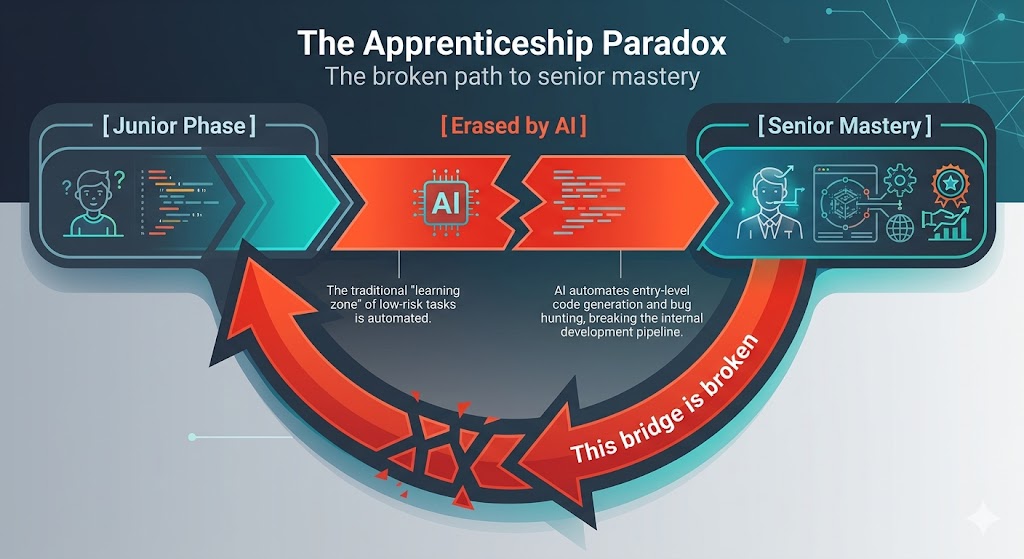
We still desperately need senior engineers. AI can generate code, but it cannot architect complex, highly distributed systems, understand nuanced human business requirements, or maintain a holistic view of security, compliance, and long-term technical debt.
But senior engineers aren’t born; they are forged. If the bridge between “zero experience” and “senior autonomy” is completely automated away, the pipeline dries up. Industry leaders who cut entry-level hiring to optimize this quarter’s margins are effectively eating their seed corn.
The New Path to Mastery: Becoming a “Product Engineer”
The entry-level role as we knew it is gone, and it isn’t coming back. But the demand for engineering talent isn’t dead—it has simply evolved. The next generation of developers cannot rely on the old playbook of “learning syntax” to get a foot in the door.
To survive the shift, aspiring developers must leapfrog the syntax layer and focus on the skills AI cannot replicate. The path to mastery now requires transitioning from a Code Monkey to a Product Engineer.
1. Code Synthesis Over Code Generation
AI is a hyper-fluent generator, but it is a terrible editor. The modern junior engineer must become an expert code reviewer, architect, and synthesizer. Your value is no longer in writing the function, but in verifying its correctness, understanding its performance implications, and ensuring it seamlessly integrates into the broader ecosystem.
2. Systems Thinking and Architecture
You must learn how components talk to each other before you learn how to write the individual components. Understanding database modeling, API design patterns, security protocols, and cloud infrastructure is no longer a mid-level luxury—it is an entry-level requirement.
3. Deep Domain and Business Empathy
AI doesn’t know why a feature needs to exist; it only knows how to build what it’s told. The next generation of engineers must be intensely product-focused. If you can sit with a user, understand their friction point, map out the logical solution, and use AI to build it over a weekend, you aren’t a junior dev—you’re a force multiplier.
The Onus on the Industry
The burden cannot fall entirely on new developers. If the tech ecosystem is to survive, companies must reinvent the junior role rather than erasing it.
Instead of hiring juniors to write code, forward-thinking organizations are hiring them to shadow seniors as “Prompt Operators” and system auditors. Companies must intentionally create “artificial environments” where new engineers can fail safely, read legacy codebases, and learn system design under the wing of seniors, explicitly budgeting for mentorship as an R&D expense.
The Final Verdict
The death of the entry-level role is terrifying, but it is also deeply liberating. It means the boring, mundane, repetitive parts of software engineering are being permanently offloaded to machines.
The next generation of developers won’t have to spend years trapped in the weeds of syntax errors and missing semicolons. If they can adapt, they will start their careers higher up the leverage stack—operating as architects, product designers, and systems orchestrators from day one.
The floor is gone, but the ceiling has never been higher.